Revisiting an Old Woodburning With Watercolor
Sometimes experimenting with a new medium doesn’t mean starting from scratch. Sometimes it means pulling an old piece back out, looking at it with everything you’ve learned since making it, and wondering what would happen if you approached it differently now.
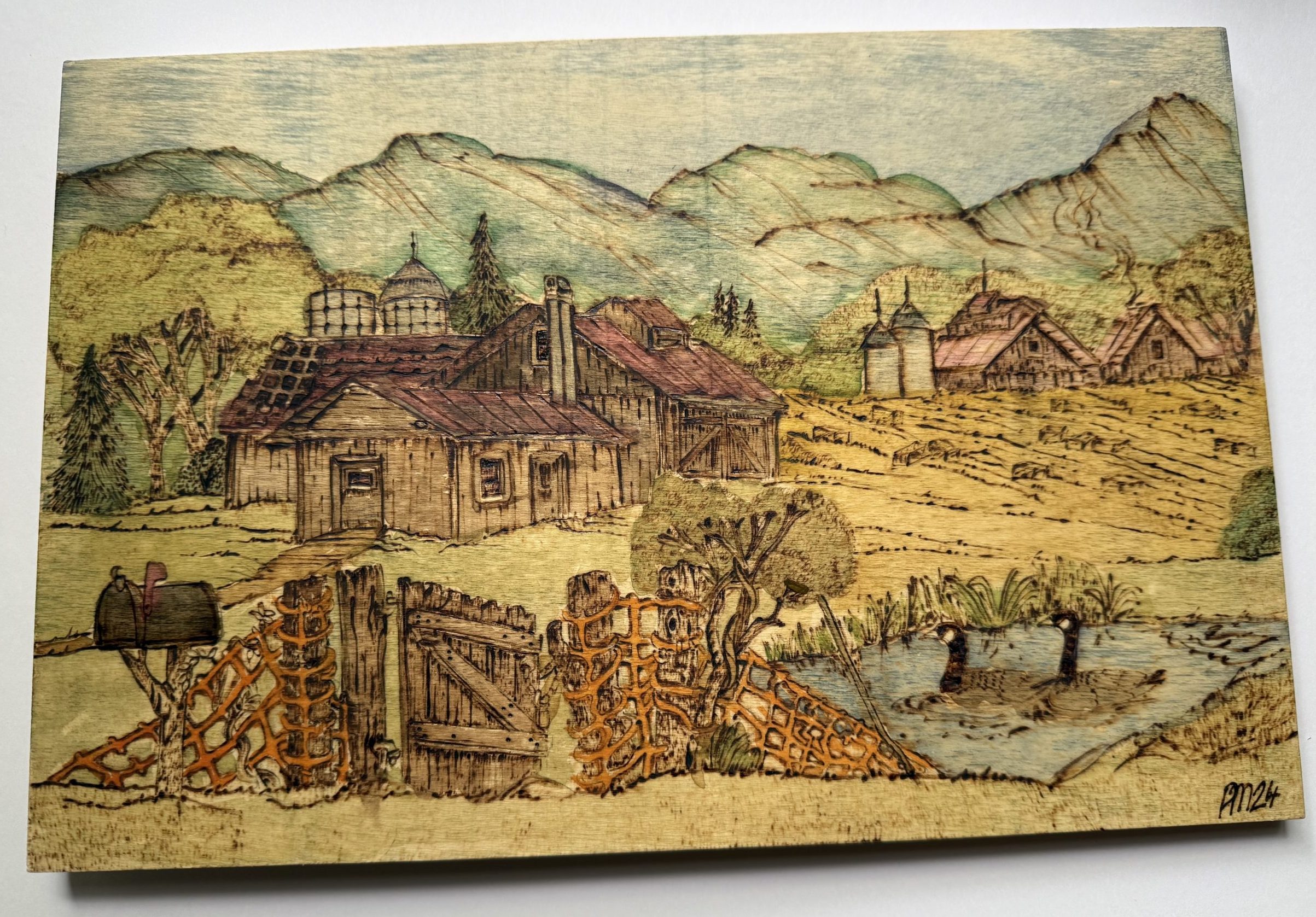
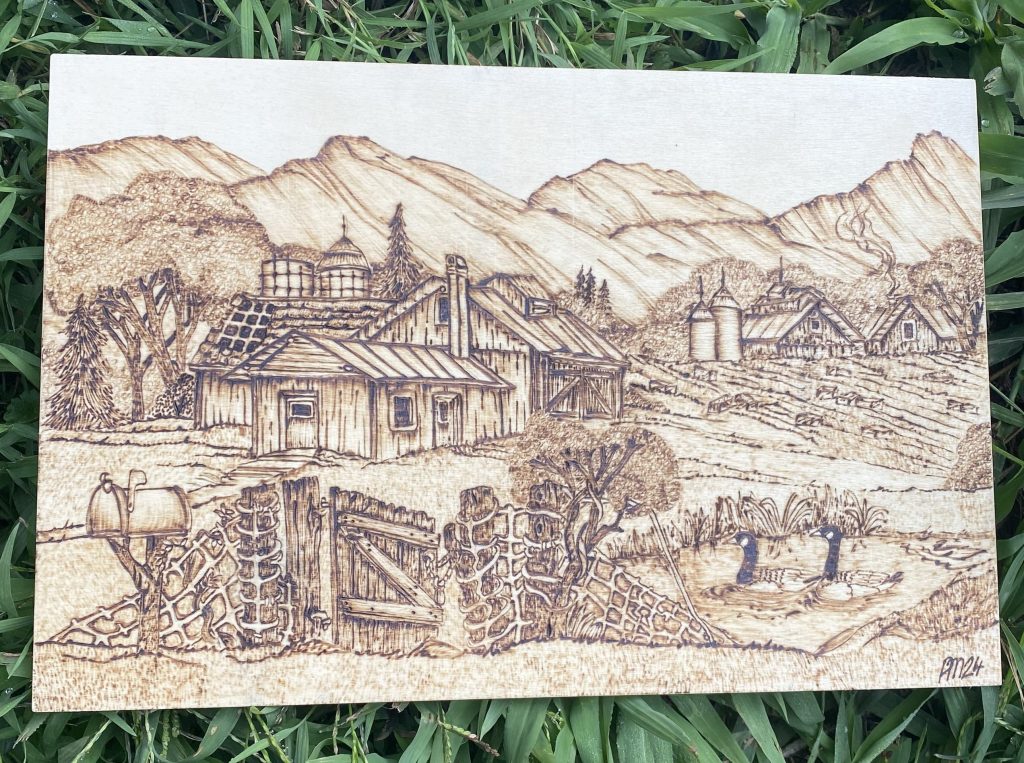
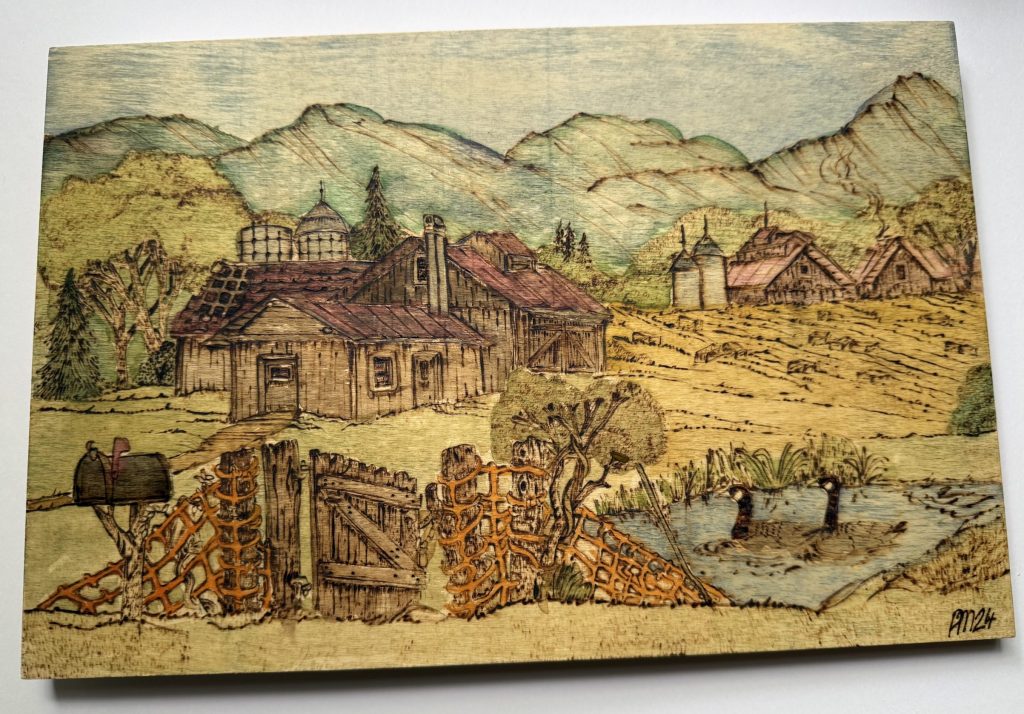
I created this woodburning in 2024. It’s a fairly detailed landscape filled with mountains, old farm buildings, stone walls, trees, fields, a pond, and a couple of geese hanging out in the water. At the time, I considered it finished. I signed it, photographed it, and moved on to whatever project had grabbed my attention next, which is generally how things work around here.
I pulled the piece back out and noticed that some of the shading had faded over time. There was still a tremendous amount of detail in the burning, but some of the separation between the different parts of the landscape had disappeared. The mountains, buildings, fields, and foreground were all competing within a similar range of brown values.
Going back over the faded areas with my burner wasn’t really an option. Like many of my finished pyrography pieces, this one had been sealed with polyurethane, and I don’t burn over a finished surface like that. If I wanted to reburn it, I would have needed to sand the finish completely off and essentially take the piece several steps backward before I could move forward again. Since I’ve been exploring watercolor lately, I decided to try something entirely different instead.
Letting Pyrography and Watercolor Do Different Jobs
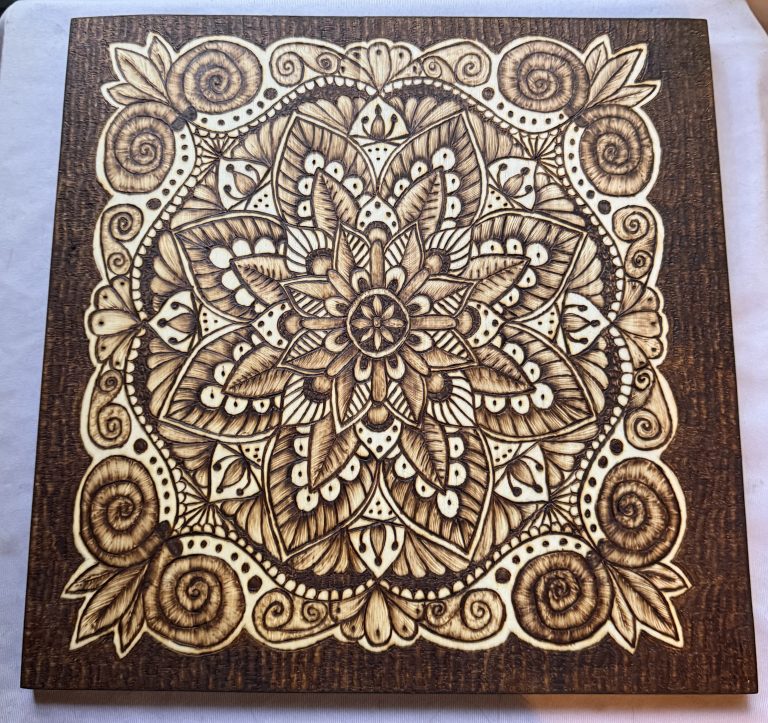
One of the things I’m discovering through my watercolor experiments is that learning another medium doesn’t mean I have to abandon or replace anything I already do. I’ve worked with pyrography for years, and there are things burning can do that I don’t want watercolor to replicate. Burned lines create structure, texture, and depth that feel completely at home on wood, especially when I’m working with bark, stone, architecture, feathers, grasses, and all the tiny details I tend to get lost in.
Watercolor gave me another way to create depth without simply darkening the burning. I added muted blue-greens to the mountains, warmer greens and yellows through the landscape, rusty tones to the roofs, ochre around the stone wall, and blue through the pond. Suddenly, the different areas had more separation again. The mountains moved farther into the background, the buildings became more prominent, and the pond became its own little part of the landscape rather than disappearing into everything around it.
What mattered most to me was keeping the watercolor transparent enough that the pyrography was still doing most of the work. I wasn’t interested in painting over the woodburning or turning the burned marks into outlines for a painted picture. I still wanted the grain of the wood to show, and I wanted all those burned textures and details to remain part of the finished piece. The watercolor needed to support what was already there rather than cover it.
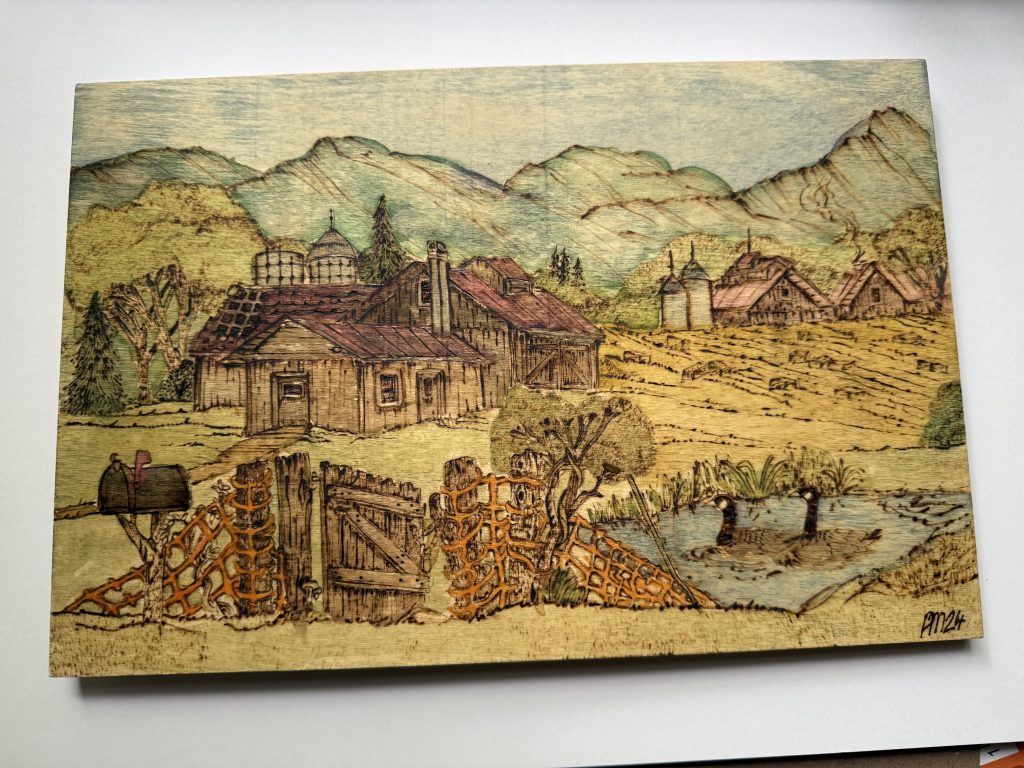
Finding the Original Photograph Changed How I Saw It
At first, I couldn’t find a photograph of the piece before I added the watercolor. Then, naturally, after I had already finished painting it, I found the original photo.
Seeing the two versions side by side was interesting because the original was actually more detailed and dimensional than I remembered. This wasn’t an unfinished or unsuccessful woodburning that needed watercolor to rescue it. I liked the original when I made it, and looking at the photograph now, I still do. What had changed was partly the piece itself as some of the shading faded, but I had changed too.
And here’s the thing: I don’t want exploring watercolor to turn into looking back at everything I’ve created and deciding my older work needs fixing. The original represents how I worked at that point in my creative life, while the watercolor version reflects some of what I’m curious about now. Instead of replacing the old piece, I essentially created another version of it.
There’s something I really like about that. The original was made by the artist I was in 2024, and instead of starting over, I got to collaborate with her a little.
What If the Watercolor Is Part of the Plan?
The biggest takeaway from this experiment is that the watercolor was an afterthought, and now I want to see what happens when it isn’t. This landscape was completely burned and finished before I ever considered adding paint, which means I had already used pyrography to solve every problem in the composition. The shadows, textures, values, distant mountains, foreground, and tiny details were all created with the burner because that was the only medium I intended to use.
If I had known watercolor was coming from the beginning, I could have approached the burning differently. I don’t necessarily need to burn every shadow or create every tonal transition with the pyrography pen. I can let the burner establish the structure, darkest values, textures, and details while intentionally leaving other areas lighter for transparent washes of color.
That opens up quite a few possibilities for the kind of work I’ve been wanting to create around the Blue Ridge. Distant mountains could have loose washes of blue and green while burned lines define ridges and exposed rock. A botanical piece could combine burned stems, veins, and bark textures with watercolor leaves and flowers. Wildlife could have carefully burned features and fur textures, surrounded by softer-painted landscapes. Even something as simple as a trail scene could use the contrast between permanent burned marks and loose watercolor to distinguish rocks, roots, foliage, sky, and distant terrain.
Bringing My Different Ways of Making Together
This experiment also landed at an interesting time because I’ve been thinking quite a bit about watercolor, pyrography, surface pattern design, illustration, and where all of those things belong within Wild Ridge Studio. After spending several days in Asheville recently and seeing artists working across all kinds of materials and styles, I came home even less interested in forcing myself to choose one medium and stay obediently inside its boundaries.
What I’m beginning to see instead is that the connection between my work doesn’t have to be the material I use. It can be the subject, the observation, and the place it came from. A hike might give me photographs, sketches, colors, plants, textures, and little details I want to investigate further. One of those observations could become a watercolor study, another a woodburning, and some of those same shapes might eventually become motifs for a surface pattern or another Wild Ridge Studio piece.
That idea fits particularly well with the Field Studies I’ve started developing. I can study a mountain, tree, plant, animal, or trail without deciding beforehand what the final artwork will become. Watercolor can be part of learning the subject rather than something I have to master as an entirely separate artistic identity. Pyrography can come into the process when the subject calls for it, and surface design can grow from the motifs and observations I collect along the way.
An Old Piece and a New Direction
I didn’t pull this woodburning out because I was looking for a new direction. I pulled it out because some of the shading had faded, I had watercolor nearby, and I was curious to see what would happen if I combined two things I enjoy. The experiment turned into something much more useful than simply refreshing an older piece, because it showed me how these media can work together without either one losing what makes it interesting.
Now I want to make another one, but this time I want to start with the combination in mind. I want to see what happens when I deliberately leave room for watercolor while I’m burning, use each medium for the things it does best, and allow more of the wood itself to remain part of the artwork.
I don’t know exactly what that will look like yet, which is probably the part I like most. I’m not particularly interested in deciding that watercolor pyrography is suddenly the thing I do or turning one experiment into another rigid creative rule. I’m interested in following the curiosity, making another piece, paying attention to what works, and seeing where it leads.
For now, that’s enough of a reason to keep going.