How a Hiking Boot Became an Entire Collection
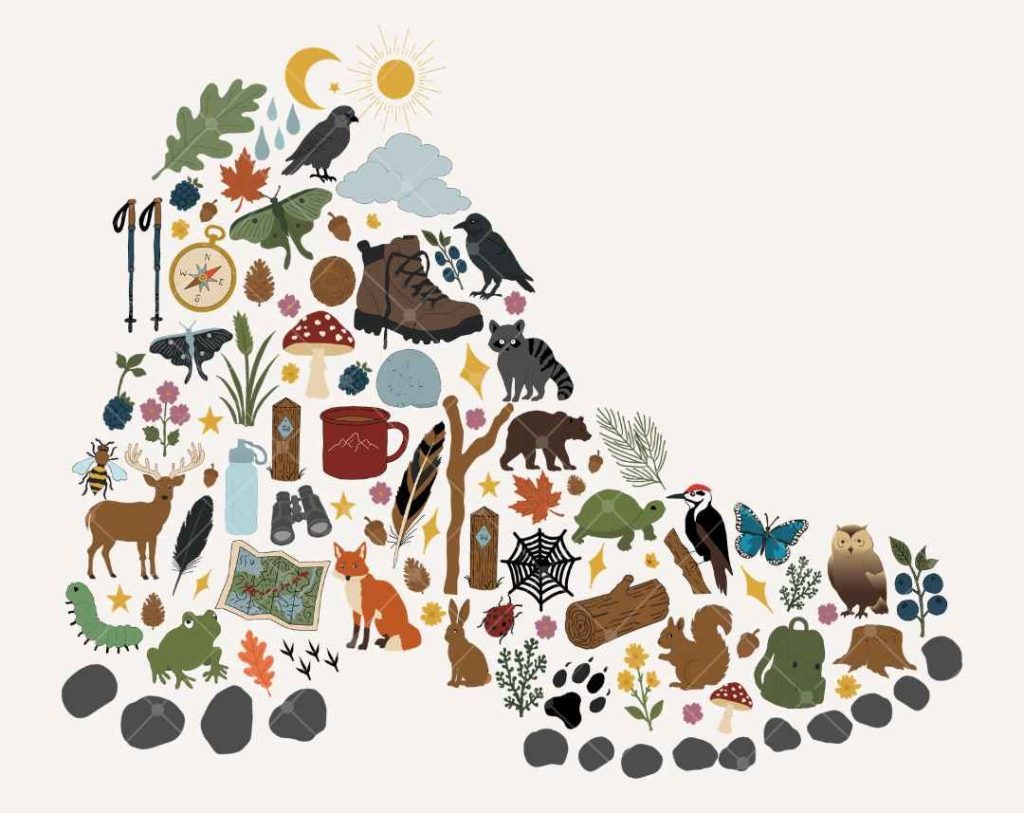
The Hiking Boot Collection started with one idea: creating the shape of an old hiking boot entirely from the things I notice along the trail. Wildflowers, leaves, mushrooms, moths, ferns, and all those little botanical bits and pieces that tend to catch my attention when I’m supposed to be walking.
Instead of drawing a boot and decorating it with nature, I wanted the nature itself to create the boot. The individual motifs would have to work together to form the recognizable outline and structure while still being interesting little illustrations on their own, and this meant I needed many motifs.
Before There Was a Boot, There Was a Pile of Drawings
I knew roughly what I wanted the finished piece to look like, but getting there meant building up a pretty substantial library of individual elements first.
I drew flowers, leaves, mushrooms, insects, ferns, and other bits inspired by things I’ve noticed while hiking. Some were larger and more detailed. Others were deliberately smaller or simpler because I knew I would eventually need different shapes and sizes to make the composition work.
This is where creating this kind of collage gets interesting because you’re thinking about more than whether an individual motif looks good. You’re also thinking about shape.
A curved fern can do something a round flower can’t. A long leaf can help define an edge. A mushroom has a completely different visual weight than a tiny blossom. Each motif becomes both an illustration and a building block. Eventually I had enough pieces to start constructing the boot.
Building the Boot Was a Bit Like Putting Together a Puzzle
This wasn’t a matter of placing everything inside a boot-shaped container. There wasn’t actually a boot underneath all those motifs.
I started arranging and rearranging them until the overall silhouette began reading as a hiking boot. Some pieces helped define the sole and toe. Others worked along the ankle and upper edges. Smaller motifs helped fill awkward spaces without completely closing everything in. There was a lot of moving things around.
Something could look perfect on its own and be completely wrong once I put it into the composition. Another motif I hadn’t thought much about could suddenly be exactly the shape I needed to make one section work. That’s one of my favorite things about working this way. At some point, you stop seeing a collection of mushrooms, flowers, leaves, and insects and your eye starts seeing the larger shape they’re creating together.
But I also didn’t want the boot to become so perfectly defined that you stopped noticing what it was made from. That balance became part of the challenge.
Then I Realized I Had Built More Than One Piece of Artwork
By the time the hiking boot was finished, I had created a pretty substantial motif library. And all those drawings had already done one job. They had worked together to create the boot. But they didn’t have to stop there.
Because they were created for the same piece, they already shared a visual language. They had similar line work, detail, subject matter, and overall feeling. I didn’t have to figure out how to make a random mushroom I drew six months ago coordinate with a flower I drew yesterday.
Taking the Boot Apart Again
There’s something slightly entertaining about spending all that time arranging dozens of individual elements into a single recognizable composition, only to immediately pull everything apart again, but that’s what happened next.
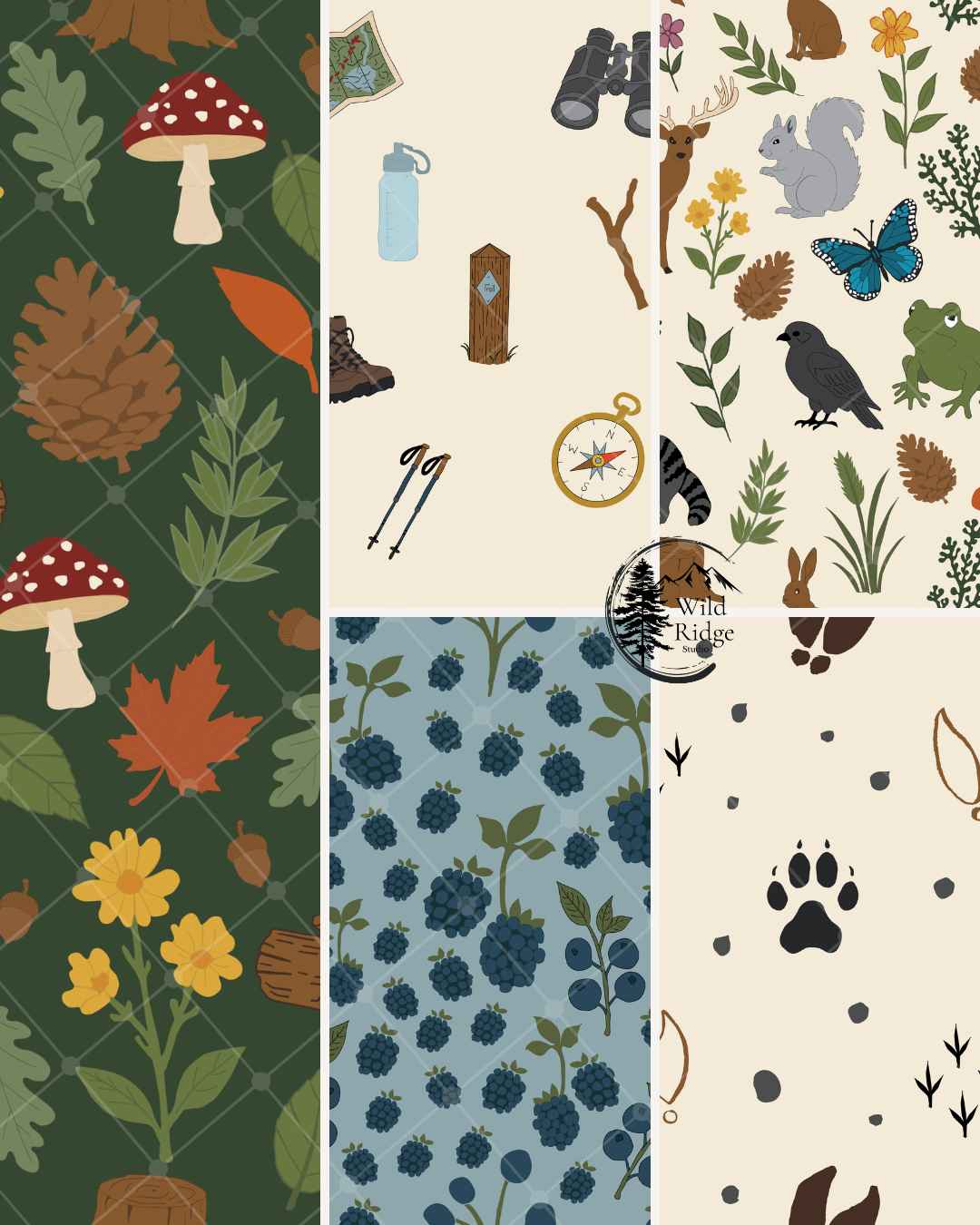
I started experimenting with the individual motifs outside of the boot. Which ones were strong enough to become focal elements? Which ones worked beautifully together? Which quieter elements could become supporting patterns? What happened when something that had been tiny in the original collage suddenly became much larger?
Those questions began to lead toward the surface pattern collection. And this is something I’ve become increasingly interested in with my own work: how much mileage can I get from the artwork I’ve already taken the time to create?
Not in a churn-out-more-products-from-the-same-thing kind of way, but creatively.
What else is hiding in there?
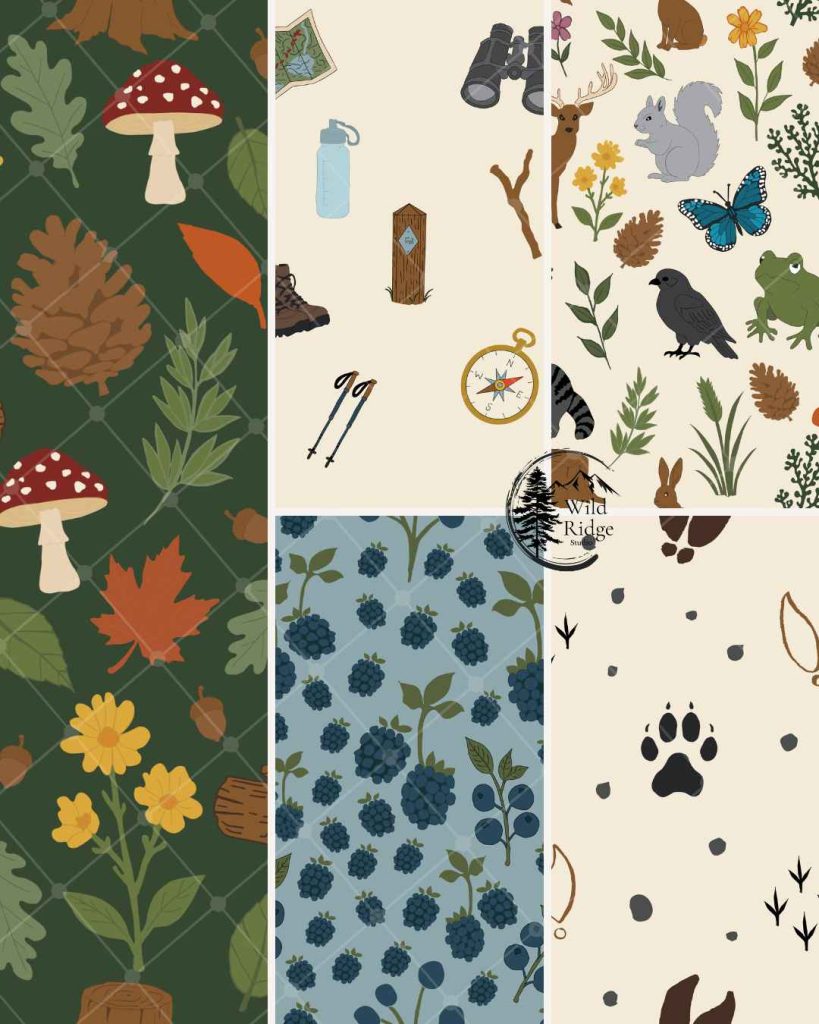
Building a Collection Isn’t the Same as Making More Patterns
Once I started working with the motifs as a collection, I didn’t want every pattern to look like someone had shaken the hiking boot until all the pieces fell onto the canvas. They needed relationships, but they also needed differences.
If I used every flower, mushroom, moth, fern, and leaf in every pattern, everything would technically coordinate, but nothing would be particularly interesting. Some designs could be detailed. Others needed to be quieter. A motif that played a tiny supporting role in the hiking boot could suddenly become the focus of another design. A few simple elements could work together without needing the entire motif library to come along for the ride.
That’s where I think collection building becomes much more interesting than simply creating a series of seamless repeats. The goal isn’t necessarily to make everything match, but to make everything belong.
The Same Motifs Could Do Something Else Again
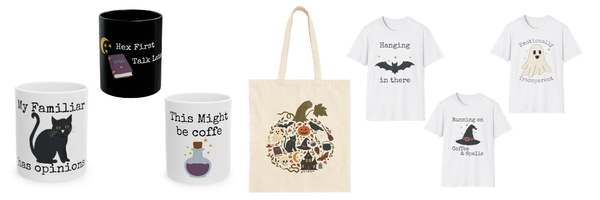
I also knew I didn’t want the collection to exist only as repeating patterns. Wild Ridge Studio artwork eventually finds its way onto mugs, shirts, totes, prints, paper goods, and other products, and those formats don’t always need the same kind of artwork.
So I went back to the motif library again, and this time I wasn’t thinking about repeats. I was thinking about placement, artwork, and composition.
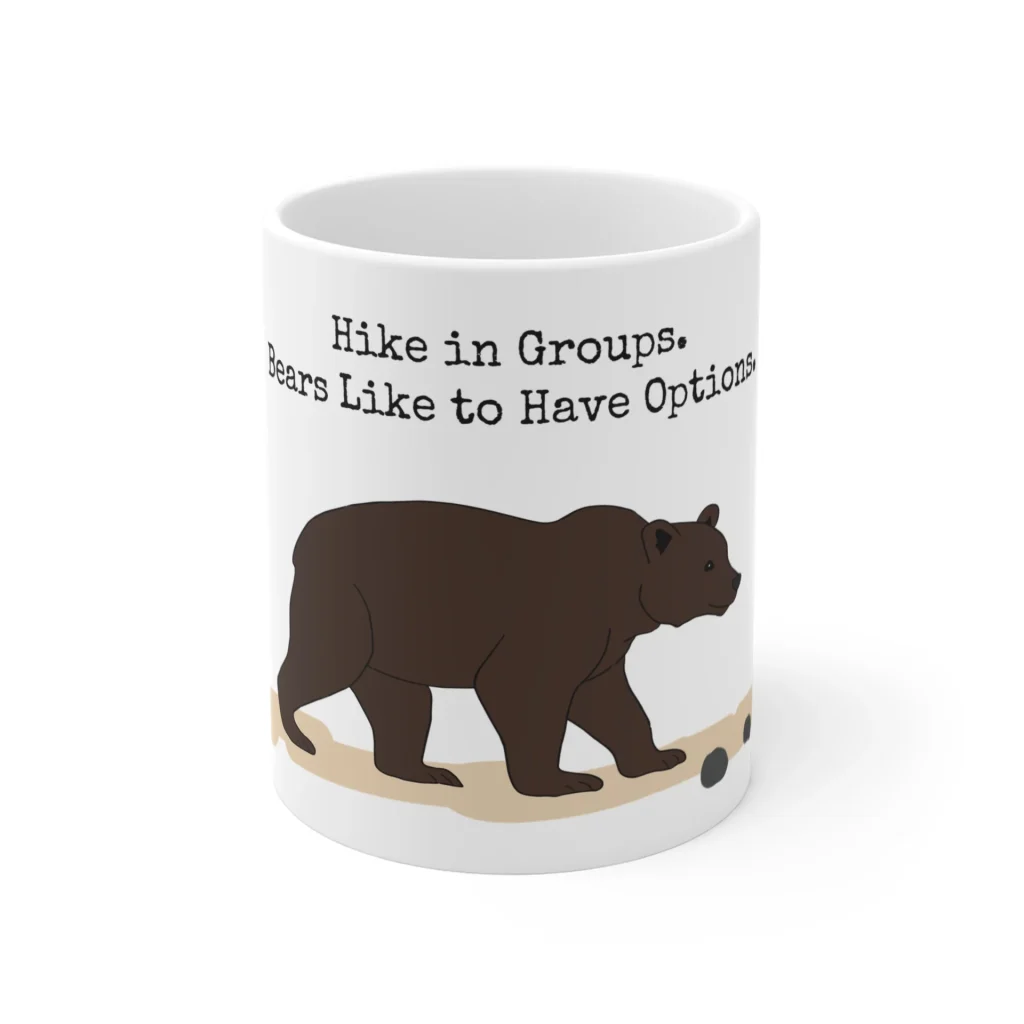
A mug gives me a completely different space than a shirt. A tote can handle something larger and more graphic. An art print gives me room for detail. Each one creates a different problem to solve.
The motifs stay connected to the original hiking boot, but they don’t have to recreate it every time.
That’s where a collection starts becoming incredibly useful. I’m not creating one piece of artwork and putting it on twenty different things. I’m building a visual world that can shift depending on where the artwork needs to live.
Creating More Doesn’t Always Mean Drawing More
There’s a funny contradiction in this collection because I absolutely drew a ton of motifs to make the original hiking boot work; there was no shortcut around that part. But once I’d created them, I didn’t automatically need to sit down and draw another giant batch of artwork to turn the boot into a collection. I needed to understand what I already had.
That’s something I’ve been working on more intentionally in my own creative practice. Sometimes a collection genuinely needs another motif. Sometimes a shape, scale, or subject is missing, and drawing something new is exactly the answer. But sometimes the answer is already sitting in the artwork.
Maybe I need to change the scale. Maybe I need to separate motifs that have always appeared together. Maybe one tiny element deserves to become the focal point. Maybe I need fewer elements instead of more.
Instead of immediately asking, What else can I draw?, I’m also learning to ask, “What else can I do with what I’ve already drawn?”
From One Idea to a Visual World
That’s probably the biggest thing the Hiking Boot Collection has reinforced for me. I started with the idea of building a hiking boot from the little things I notice while I’m outside. To make that possible, I created a library of individual trail-inspired motifs and slowly assembled them until those separate pieces became something completely different when viewed together, and then I took them apart again.
Those same flowers, mushrooms, moths, ferns, leaves, and other little trail finds became the foundation for patterns and placement artwork that could move well beyond the original boot while still being connected to it.
There are plenty of technical decisions underneath that process that I’m not getting into here. How I decide which motifs belong together, how I know when a collection needs something else, how I build the repeats, and how I adapt artwork for different products are conversations all their own.
But the larger idea is something worth remembering.
A finished illustration doesn’t necessarily mean you’ve reached the end of an idea. Sometimes you just have to find a way to give your art more places to live.